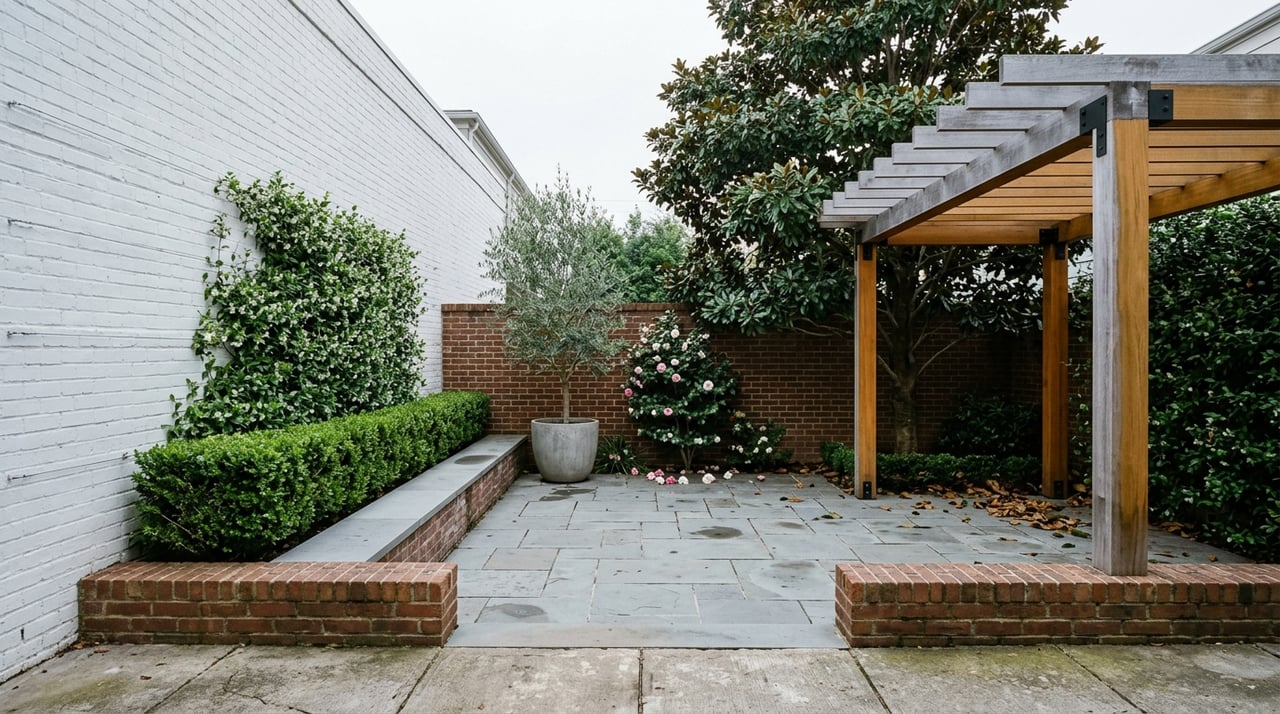
Wedgewood-Houston's Old Hosiery Mills Are Now Home to Hermès, a Bookstore, and a 4,400-Seat Concert Hall
August 27, 2026
August 27, 2026
What does the company that made Neil Armstrong's socks have in common with a French luxury house, a bookstore run by one person, and a room built to hold 4,400 people watching Miranda Lambert?
They all share an address. May Hosiery Mills once ran the largest sock factory in the South, and its hand-finished knit goods reportedly went to the moon on the feet of an Apollo astronaut. That building, along with the rest of the old industrial stock scattered across Wedgewood-Houston, is now doing something stranger than the usual story of a warehouse district going upscale. It's holding a luxury handbag counter and a neighborhood bookstore at the same time, sometimes in the same four floors. If you've lived here through the last few years of construction fencing and rerouted sidewalks, this fall is the season where you finally see what all of it adds up to.
Hermès opened a two-story unit inside the old hosiery mill complex last October, the first major luxury retailer to sign on with AJ Capital Partners' Wedgewood Village project. Brunello Cucinelli followed in March. Hermès America's president Diane Mahady put it simply when the doors opened: "We love the location, the store is absolutely beautiful." The appeal wasn't in spite of the building's past as a sock factory. It was because of it.
That detail matters more than it sounds like it should. A global fashion house chose exposed brick and old sawtooth rooflines over a mall storefront, on purpose, because the industrial bones read as authentic in a way a new build can't fake. Zimmermann, Staud, and Malbon have all signed on to follow with their own storefronts in the same development, each occupying a couple thousand square feet inside buildings that used to make hosiery, not handbags.
Here's where the story stops being a simple luxury-retail arrival and starts being something more specific to how this neighborhood is being built. Walk one block from the mill to the four-story building on Martin Street, 170,000 square feet total, and you'll find Bell Bird Books, a 1,020-square-foot independent bookstore founded by Mary Ann Weprin, sharing a ground floor with a design-forward nail studio called Bower and a frozen Greek yogurt shop called Culture Club, founded by brothers Bear and PJ Kaminer. Perenn, the bakery and café known around town for its bread, is set to open a grocery concept in the same lineup this summer.
Go up from there and the same building holds Momotaro and Alla Vita, two James Beard-recognized restaurants from the Boka Restaurant Group. Go up further and you're in Memoir May Hosiery, 109 residential units with a rooftop pool and a 24-hour fitness studio. One developer, one building, one lease structure putting a solo-founder bookstore, a national restaurant group, and market-rate apartments under the same roof. AJ Capital's retail lead Kyle Allen has described the strategy plainly: pairing small, locally owned tenants with national and global names deliberately, not as a placeholder phase before the independents get priced out.
That's the part worth sitting with if you live here. The usual arc for a neighborhood like this one is displacement, where the funky stuff draws attention, rents rise, and the funky stuff leaves. What's happening on Martin Street is not that. It's stacking, not swapping.
The most-watched arrival this fall isn't retail at all. The Truth, Live Nation's new 4,400-capacity venue on Chestnut Street, opens October 1 with a one-night-only Miranda Lambert show, timed so she can release a new album called Crisco at midnight the same night. Tickets went on sale August 21, just days before this was written, after a fan club presale and a Live Nation presale earlier that week.
The number 4,400 sounds arbitrary until you put it next to the two venues Nashville touring acts have had to choose between for years. The Ryman seats roughly 2,360. Bridgestone Arena holds close to 20,000 for a concert. Everything in between has meant an artist either plays the Ryman twice or plays downtown to a half-full arena. The Truth is built directly in that gap, close enough to Ryman-sized intimacy to still feel like a room, big enough to make a two-night Ryman run unnecessary. That's not a marketing detail. It's the reason touring rosters that skip Nashville's mid-size options might start routing through Wedgewood-Houston instead.
Inside, the venue includes Harlan's, a whiskey bar named for the late songwriter Harlan Howard, and a two-story listening lounge called the Vinyl Room, both built as tributes to the neighborhood's music history rather than generic concert-venue amenities. Live Nation projects the venue will generate $74 million in annual economic impact for the city, support around 430 jobs, and contribute $6 million in state and local tax revenue once it's running at capacity. Those are the company's own projections, not a measured result yet, since the venue hasn't opened a single show.
Not everything landing in Wedgewood-Houston this year is chasing scale. Sally's Stay Awhile opened June 4 in the former Smokin' Thighs space on Wedgewood Avenue, a 66-seat restaurant from Strategic Hospitality with two patios and a menu built to shift from breakfast to dinner rather than lock into one identity. Strategic Hospitality founder Benjamin Goldberg described the intent behind it directly: "The goal was to create a place that feels natural to people's daily routines."
It has 30 parking spots, which locally counts as a punchline given how tight parking has become around Wedgewood Avenue on Nashville SC match days. But the bigger point is what the restaurant is trying to be. Not a destination people drive across town for once, but a stop on the way to work and again on the way home. That's a different bet than a luxury flagship or a 4,400-seat venue, and it's a bet a lot of longtime WeHo residents will recognize as closer to what drew them here in the first place.
None of what's arriving this fall created the neighborhood's identity. That credit goes to the first Saturday of every month, when roughly a dozen galleries throw their doors open for the WEHO Art Crawl, a tradition running since 2013 that predates Hermès, predates The Truth, and doesn't require a lease from AJ Capital to keep happening. David Lusk Gallery and Zeitgeist Gallery on Hagan Street, along with Julia Martin Gallery, anchor a self-guided route through studios and creative spaces that's remained free the entire time the neighborhood around it has gotten considerably less so.
That contrast is worth keeping in view. The art crawl is the one fixture in this story that isn't tied to a corporate opening date or a projected economic impact figure. It's just people showing up, on foot, on the same Saturday they've shown up on for over a decade.
Put those four threads together and the pattern isn't subtle. A global luxury brand chose this neighborhood specifically for its industrial history rather than in spite of it. A developer is deliberately housing a one-person bookstore in the same building as a national restaurant group and market-rate apartments. A concert promoter identified a size gap in Nashville's live-music infrastructure and built a room to fill it exactly, timed to open with one of country music's bigger names. And underneath all of it, a free monthly art crawl keeps running exactly as it has since 2013, unbothered by any of the money moving in around it.
Whether that mix holds, or whether the independent tenants eventually get squeezed out once the leases come up for renewal, is the honest open question. For now, Wedgewood-Houston in the fall of 2026 looks less like a neighborhood being replaced and more like one being layered, with the old sock factory doing double duty as a luxury retail anchor and a talking point for exactly how strange that layering can get.
If you're the kind of person who likes knowing what's actually happening on your own streets before it shows up in a headline, that's the kind of thing we track here at The Real Deal Radio. We're a Nashville and Middle Tennessee team built around plain answers and local detail, not sales pressure. If you ever want to talk through what a neighborhood shift like this one actually means for the block you live on, reach out. We're happy to talk it through, no pitch attached.
Stay up to date on the latest real estate trends.
Go beyond the broadcast with direct guidance rooted in legal expertise and real estate experience.